LN 1: Information and Its Consequences...
Standard: Logic
Loading content...
Standard: Logic
Let's begin with a brief exercise. Pause where you are and relax. Just exist in your space for a moment.
Focus on your surroundings and the sensations you're experiencing:
Think about what your senses are telling you about your environment right now.
Let's organize those observations into a table. Below is my own experience from my office where I'm writing these notes:
| 👁️ See | ✋ Feel | 👂 Hear | 👅 Taste | 👃 Smell |
|---|---|---|---|---|
| The VSCode window | The keyboard | The keys clack | A chocolate milk | Old carpet |
| Colorful fruit erasers | Soreness from rock climbing | My office fridge hum | — | — |
Our senses gather information about the world for free—we can't help but see, feel, hear, taste, and smell. They act as the very first step in understanding our environment.
🤔 But wait... Is there any other way we can organize this information? It would be limiting if the only way we could understand the world was through our senses. By now, we've all recognized it's possible to trick our senses. We need a more objective method.
Instead of organizing by sense, let's try organizing by Things, Properties, and Interactions:
| 📦 Things | 🏷️ Properties | 🔄 Interactions |
|---|---|---|
| The VSCode window | Colorful | The keys clack when I type |
| The keyboard | Plastic | I drank the chocolate milk |
| My office fridge | Old | Fridge hums |
| Erasers | Fruit-shaped | — |
This organization is thing-centric rather than sense-centric—a more objective way to structure information!
💡 Side Note: Does this pattern look familiar? It's Object-Oriented Programming!
Our Terms OOP Terms Things Objects / Instances Properties Attributes / Fields Interactions Methods
"Stuff that is accurate of the world."
More formally, information is any Discrete Atomic Truth-functional Statement.
Let's evaluate some statements:
| Statement | Truth Value |
|---|---|
| "The sky is blue" | ✓ True |
| "The sky is not blue" | ✗ False |
| "The grass is green" | ✓ True |
| "Cars are loud" | ✓ True |
| "My office has no A/C" | ✓ True |
⚠️ Pause and consider: Do you agree with all my evaluations above? The world is objective, right? So if you disagree, one of us must be wrong...
But here's the real question: How many of you read "My office has no A/C" and thought "I don't know"?
You understand there should be a truth to that statement, but you don't have proof of it.
In this class, we'll study a form of logic that allows us to say "I don't know."
There's a common notion that everything expressible must be either true or false. But what about recognizing when we aren't there yet?
📌 Key Insight: Recognizing when we don't have enough information to decide is incredibly powerful! We have limited knowledge of the world—we're "trapped" by our own experiences. In much the same way, our computers are "trapped" by their limited memory. We can't know everything, and neither can our machines. So why not investigate a system that acknowledges this?
Consider the image below. Pretend for a moment that this is the only information you have about the world.
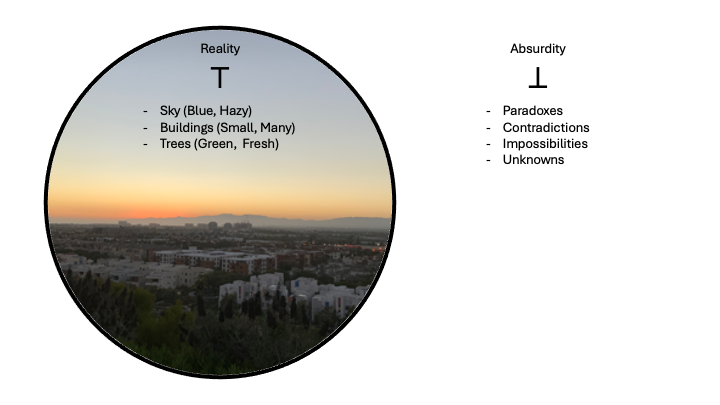
Using only this picture, evaluate the following statements:
| Statement | Your Evaluation |
|---|---|
| "The sky is blue" | ? |
| "The trees are green" | ? |
| "The buildings are white" | ? |
| "The sky is green" | ? |
| "The people are happy" | ? |
What's wrong with that last statement? Unsure?
What if I asked you to evaluate: "The glorp is blue"?
The problem is: What is a glorp? I don't know what that is! Is it in the picture? Is it not? We don't know!
Rather than forcing ourselves to say True or False, we can say "I don't know"—or more formally, that it is Absurd.
The diagram is constructed with a border around the image and infinite whiteness beyond it on purpose:
| Region | Name | Contains |
|---|---|---|
| Inside the border | Reality | Everything we know to be True or False |
| Outside the border | Absurd | Everything we cannot comprehend |
⚠️ Important: We don't know anything about what's outside the border! Not understanding what a "glorp" is is not the same as dividing by zero. We're unsure in both cases, but the nature of the uncertainty could be completely different!
When do we say something is True, False, or Absurd?
Use the room you're currently in as your limited reality. If you're not in a room... pretend you are!
Statement: "Tables are made of wood"
| Evaluation | Requirements |
|---|---|
| True | You have a table in the room AND it's made of wood |
| False | You have a table in the room AND it's not made of wood, BUT you have wood in the room (so you understand both concepts) |
| Absurd | You have no table in the room (unknown concept) OR there's no wood (unknown concept) |
Statement: "The sky is blue"
| Evaluation | Requirements |
|---|---|
| True | You can see the sky AND it's blue |
| False | You can see the sky AND it's not blue, BUT you have something blue visible (so you understand both concepts) |
| Absurd | You can't see the sky (unknown concept) OR nothing blue is visible (unknown concept) |
📌 Clarification: This is NOT a subjective reality based on what you think is true. It's based on what you know via the evidence of your own experiences. Subtle but important difference!
We don't yet have a mechanical way to evaluate large compound statements with mixed truth values, but we'll learn that in coming lectures!
We've spent today building up Intuitionistic Logic as our first reasoning system—one based on the idea that we can only reason about information we can directly observe and prove.
But it's not the only system! In fact, it's not even the most common system. Let's explore the landscape of logic:
Loading graph...
Key Takeaways: